
Introduction
The Simpsons, during its golden age, had a number of vicious but insightful points on formal education. There is the recurring use of standardised shortcuts instead of effective teaching practice, the challenges associated with funding National education systems and the consequences of a classical conditioning teaching approach.
A personal favourite of mine is Homer’s jubilation at being accepted into college, which leads to him disdainfully burning his high school diploma (and the house) while proclaiming his genius (“I am so smart! I am so smart! S-M-R-T!”). To this day, I inadvertently hum the tune to myself whenever I accomplish any task of consequence in my role in MTU.

image via https://twitter.com/quotessimpson/status/458364726372990976
It’s a ridiculous scenario, but — like with most things related to the Simpsons — it does point to a truth of sorts. In formal education, we are mostly focused on the next bigger, better award or task. Our past achievements are typically only a means to keep reaching upwards and, once we are onto the next stage, the learning and achievements that got us there are only fit for kindling.
It is against this profile, and in the current digital context, that the ePortfolio stands out as a tool that not only supports education, but records it in a meaningful way. The purpose of an ePortfolio can be many things – it can be a tool or technology, a practice, a pedagogical model, an assessment method and a framework for learning (Chen & Black, 2010) – but at its heart, it is a way of recording what learning has been achieved with the intention of putting this to use in a relevant manner.
It is in this context that the use of an ePortfolio offers not just a too for learning or assessment, but a resource that can be of use to the student throughout their learning journey – not only from year to year, but after concluding and even before they have started their path in formal education.
The benefits of using ePortfolios
One reason that ePortfolios can offer such utility is due to their flexibility. It “can be implemented across the whole institution but is flexible enough to meet the diverse needs of the different stakeholders” (Lambert & Corrin, 2007) and “boasts greater flexibility as it can be easily revised, transferred, and navigated” (Ngui et al, 2020).
If we consider an ePortfolio part of our toolkit to support digital teaching and learning, it is a toolkit within a toolkit. The flexibility of the ePortfolio means it can be leveraged to many purposes and applications. An ePortfolio:
- Can be formative or summative (Cotterill & Hammond, 2006)
- Can allow for assessment, evidencing, reflection, etc. (Syzdykova et al, 2021)
- Can encourage critical thinking skills, reflection skills, etc. (Puig et al, 2020)
- Can allow for a variety of media and modalities (Wills & Rice, 2013)
The barriers to ePortfolio adoption
Despite this, the use of ePortfolios in Irish Higher Education can be few and far between. One may well ask — if it is a tool that offers so many uses, then why is it not more widely used? In a recent excellent ILTA journal, a highly useful chapter “Eportfolio in Ireland: A landscape snapshot of current practice” identifies that “it is particularly noteworthy that hardly anyone in the study reported evaluating their ePortfolio practice. In addition, our findings indicate that the implementation and adoption of ePortfolio by Irish HEIs has been quite uneven, the majority of institutions were reported to be at the early stages of adoption” (Farrell et al, 2021). Barriers to adaptation were identified as:
- Academic workload
- Lack of support
- Absence of institutional buy-in
- Lack of awareness about ePortfolio
Despite the benefits which an ePortfolio can offer in theory, manifesting these benefits in practice can be a much harder task. With a tool that can be used almost anywhere, it can be difficult to pin down how and when it should be used.
ePortfolio Pilots within MTU Cork
So the benefits to ePortfolios are substantial, as are the barriers to adoption. Within the Dept of TEL in MTU Cork, we have been focusing on a number of small-scale pilots around the use of ePortfolios based on the above, attempting to identify where, how and when the resource may be used in the student lifecycle.
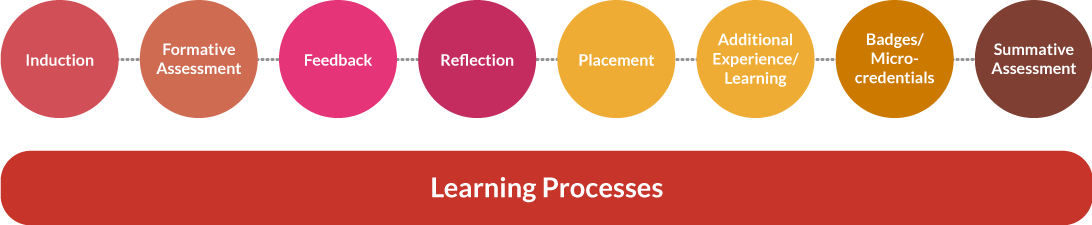
Our pilots have included the use of the ePortfolio for formative and summative assessment and feedback, as a tool for reflection, as a support for work placement, as a retainer of microcredentials and as a resource for student induction.
A visual representation is offered below:
Staff and Student Feedback
Arising from these pilots, MTU educators were very positive about the use of the tool — with the level of learner autonomy and additional flexibility around functionality being highlighted as beneficial for both formative and summative assessment purposes. One educator noted that the use of the ePortfolio can offer very straightforward or very complex experiences — e.g. as a basic learning journal and/ or as a portfolio itself as an output for assessment. It was further noted that this autonomy had the effect of allowing learners to be more creative in how they presented their work compared to a “standard upload-a-word-document assessment”.
Among students, the feedback around the use of the ePortfolio was broadly positive, but less so than among teaching staff. It was noted that technical and UX elements was a key challenge amongst students (it is, after all, the students who must know how to use all facets of the software compared to a lecturer, who only needs to be able to view the ePortfolio in order to assess it). This also led to an interesting point of reflection on the technical integration of an ePortfolio solution into a VLE. An effective ePortfolio should be somewhat separate to a VLE to facilitate the “wider use” of the ePortfolio for students — as a tool to support job-seeking for graduates, as a repository for evidencing non-academic achievement, etc. — but not so separate to a VLE or TEL ecosystem that it negatively affects the user experience switching between 2 very different systems.
It was further noted that the background and context of the students should be factored into the application of an ePortfolio. For instance, students engaged in an area of study which requires a high level of digital skills and literacy (e.g. computer science) may be — but not necessarily will be — more familiar with the process of learning to use new software and online platforms.
Additional feedback of interest highlighted that some students wished to receive more information on how the information they added to the ePortfolio would be used and how visible this information would be (and to whom). While most educational software used within a HEI often operate within the “closed walls” of that HEI (visible, by default, only to specific members of that HEI), an ePortfolio possesses the ability to make student work available to a wider audience — if appropriate.
Further ePortfolio pilots for the coming year are planned, with the intention to continue to add to this body of research and to develop a key set of best practice and application guidelines within MTU (with the intention that this research be useful or relevant to other educational institutions and stakeholders).
The wider use of ePortfolios in HE
Resulting from all of the above, the Dept of TEL has been grappling with an attempt to identify a “bigger picture” regarding the use of ePortfolios within the student lifecycle.
While the purposes and findings identified in the aforementioned piloting have been most interesting, we are aware that these are confined to separate elements within a specific learning process and that the larger benefits of an ePortfolio — as a support to students’ recording, appreciating and utilising their accomplishments throughout their learning journey — can be lost without a more holistic view.
Additional benefits outside the use of ePortfolios within the learning process are identified by Reese and Levy (2009), who note that “Universities/ HEIs can also benefit from the use of e-portfolios. Schools can use students’ e-portfolios to demonstrate that they’re meeting certain accreditation requirements or internal academic standards.”.
From a student perspective, Ferns & Comfort (2014) note the potential use of ePortfolios to graduates after completing their formal studies, whereby “E-portfolios give students another avenue to show potential employers their abilities. ePortfolios allow people to fill in gaps and demonstrate soft skills that aren’t overtly apparent on a résumé” while Juznic & Pymm (2010) note that ePortfolios can provide “…students with more confidence when seeking employment and provides employers with more information as to the range of the applicants’ knowledge and experience – it is a win-win situation for both parties”.
The use of ePortfolios alongside digital badges and/ or microcredentials touches upon the potential benefits of the tool for students, with Grush (2015) identifying that “much of the co-curricular yield from that 92 percent of the student’s college experience is either lost to or not adequately represented on the transcript or in resumes… I see the digital badge, displayed and supported in an eportfolio, as a supplement to the transcript and the resume.”. The potential of ePortfolio use alongside digital badges is echoed by Gibson et al (2015 ) who notes that “The symbiotic relationship of digital badges and eportfolios is evident in professional identity formation. Because portfolios are owner-designed and presented, they demonstrate applied learning while making learning more meaningful and making new learning connections. Endorsing and verifying this curated form of learning with digital badges is a form of warranting achievement that validates identity as a learner or professional.”
As opposed to an accomplished (at least in formal education terms) student, an additional potential application for ePortfolios relates to students seeking to enter or return to education — essentially the beginning of a student’s educational journey. In this context, ePortfolios can be a highly effective tool for the provision or evidencing of learning and/ or skills for recognition of prior or informal learning. Miller (2009) argues that e‐portfolios can assist with managing “digitally rich assets and artefacts” as evidence for skills recognition and concludes that e‐portfolios can support both retrospective and prospective approaches to Recognition of Prior Learning (RPL).
ePortfolios within the student lifecycle
To attempt to develop a framework of sorts to help us balance how ePortfolios could be used within the wider student lifecycle, highly useful research has been conducted by Lambert & Corrin (2007), who have identified that ePortfolio use can be implemented through a variety of assessment approaches:
- Academic integration via the curriculum.
- Prompted.
- Self managed.
Tangential to this, research conducted by Ring (2015) highlights the different category of portfolios:
- Showcase portfolios which highlights achievements.
- Learning portfolios which demonstrates the learning process with a focus on feedback.
- Assessment portfolios which are used to assess students’ competency on certain standards or topics.
A framework for an “evolving” ePortfolios
Based on this highly insightful research, we in TEL have sought to visualise these views according to the areas of application within the student lifecycle:
- For prospective students: The ePortfolio should be aligned to presentation of work or experience in a fairly free and informal context. This is represented as the “Personal” category below.
- For active students: The ePortfolio should be aligned to assessment requirements. This is represented as the “Academic” category below.
- For graduates: The ePortfolio should be aligned to highlighting attributes to prospective employers. This is represented as the “Job-seeking” category below.
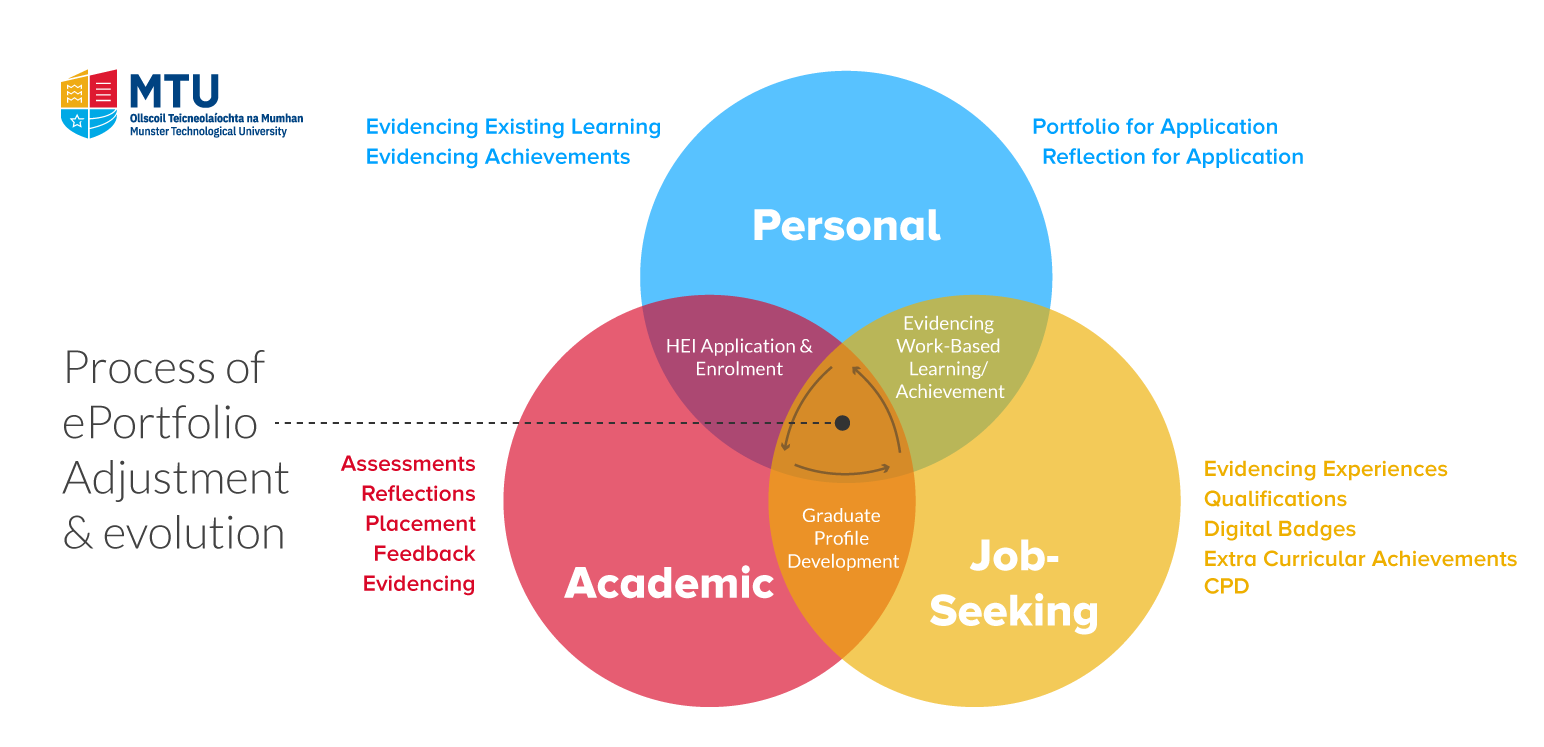
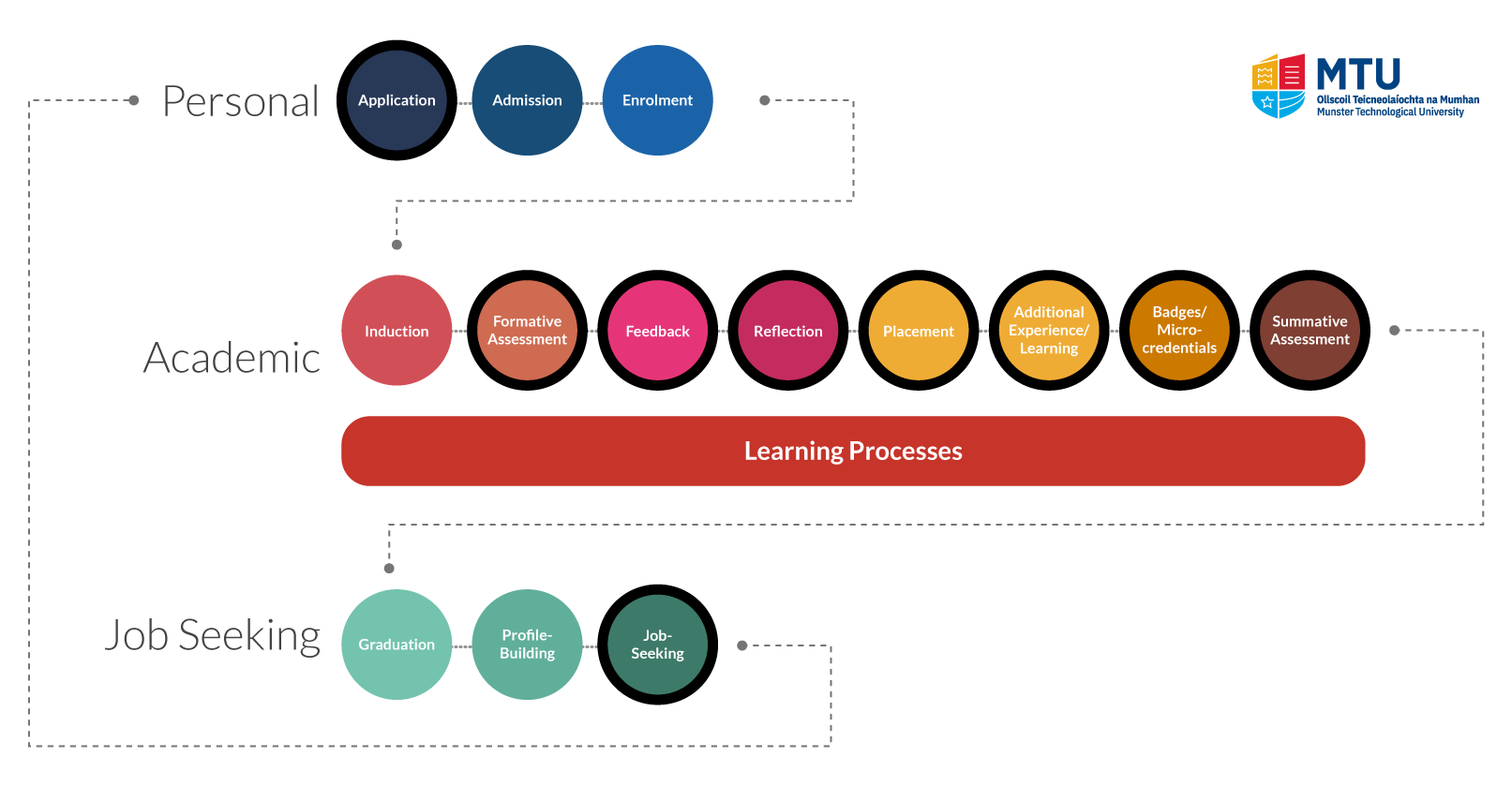
Based on this and the further analysis of the student lifecycle presented earlier, we can revisit our earlier representation of the learning process (aligned to the “Academic” category) and expand the application of ePortfolios to the “Personal” and “Job-seeking” categories to include additional crucial activities in the student lifecycle, including the use of an ePortfolio as a support for application and admission, induction, representation for Recognition of Prior or informal Learning, graduate activities (including – crucially – job seeking), etc.
ePortfolios as an “evolving” Resource
Research indicates that ePortfolios are a hugely effective tool for HEI stakeholders, due to the flexibility they offer and their ability to serve as a resource for academic, reflective or personal and job-seeking activities, all within the same online space.
As also outlined in this series however, for fully effective implementation of an ePortfolio throughout the student lifecycle, it is important to make learners aware of and familiar with the tool early and often and to support them in how to orient the tool for their purposes. While the data and artefacts within an ePortfolio can be limitless, the “orientation” of an ePortfolio — depending on the intention and the target audience — should be subject to change during the student lifecycle – for “Personal”, “Academic” or “Job-seeking” purposes.
Further beyond this, the role and benefit of an ePortfolio may lie even deeper – as a space for learners to capture, highlight and even appreciate their academic (and non-academic) accomplishments throughout their entire learning journey – both within and outside of formal education.
After all, without an appreciation for the learning we have achieved, as an accomplishment to be proud of in itself and not simply as another stepping stone, we risk, as mentioned at the beginning of this article, suffering the fallout of our own perceived smrtness.
References
Lambert, M. S., & Corrin, M. L. (2007). From optional to mandatory to assessed: updating models of university student ePortfolio use. In A conference for university teachers (p. 75).
Ngui, W., Pang, V., & Hiew, W. (2020). Designing and Developing an e-Portfolio for Second Language Learners in Higher Education. International Journal of Information and Education Technology, 10(5), 362-366.
Cotterill, S., Bradley, P., & Hammond, G. (2006). ePortfolios: Supporting assessment in complex educational environments. In Innovative assessment in higher education (pp. 211-219). Routledge.
Syzdykova, Z., Koblandin, K., Mikhaylova, N., & Akinina, O. (2021). Assessment of E-portfolio in higher education. International Journal of Emerging Technologies in Learning (iJET), 16(2), 120-134.
Puig, B., Anaya, P. B., & Bargiela, I. M. (2020). A systematic review on e-learning environments for promoting critical thinking in higher education. Handbook of Research in Educational Communications and Technology, 345-362.
Wills, K. V., & Rice, R. (Eds.). (2013). ePortfolio performance support systems: Constructing, presenting, and assessing portfolios. Parlor Press LLC.
Farrell, O., Buckley, K., Donaldson, L., & Farrelly, T. (2021). Eportfolio in Ireland: A landscape snapshot of current practice. Irish Journal of Technology Enhanced Learning, 6(1), 89-109. https://doi.org/10.22554/ijtel.v6i1.99
Reese, M., & Levy, R. (2009). Assessing the future: E-portfolio trends, uses, and options in higher education.. Available at https://er.educause.edu/
Ferns, S., & Comfort, J. (2014). Eportfolios as Evidence of Standards and Outcomes in Work-Integrated Learning. Asia-Pacific Journal of Cooperative Education, 15(3), 269-280.
Juznic, P., & Pymm, B. (2010). Students on placement: building their e-portfolio from practical experience. In World Library and Information Congress: 76 Th IFLA General Conference and Assembly.
Grush, M. (2015). Showcasing the co-curricular: ePortfolios and digital badges, A Q&A with Alex Ambrose. Strategic directions. Campus Technology , January, 2015.
Gibson, D., Ostashewski, N., Flintoff, K., Grant, S., & Knight, E. (2015). Digital badges in education. Education and Information Technologies, 20(2), 403-410.
Miller, A. (2009). The world of e-portfolio. The Knowledge Tree, 18.
Lambert, S., & Corrin, L. (2007). Moving towards a university wide implementation of an ePortfolio tool. Australasian Journal of Educational Technology, 23(1).
Ring, G. L. (2015). Implementing a peer mentoring model in the Clemson ePortfolio program. Theory Into Practice, 54(4), 326-334.